

OCD (Obsessive-Compulsive Disorder)
- Home
- OCD (Obsessive-Compulsive Disorder)
OCD (Obsessive-Compulsive Disorder)
OCD involves repetitive thoughts and behaviours that can interfere with daily life, relationships, and wellbeing.
Obsessive-Compulsive Disorder (OCD)
Obsessive-Compulsive Disorder is not simply about habits or perfectionism—it is a condition linked to how the brain processes threat, uncertainty, and intrusive thoughts.
Everyone experiences intrusive thoughts, but in OCD the brain interprets them as significant or dangerous. This triggers anxiety and a strong urge to neutralise the discomfort through repetitive behaviours or mental rituals (compulsions).
Over time, this creates a reinforced cycle:
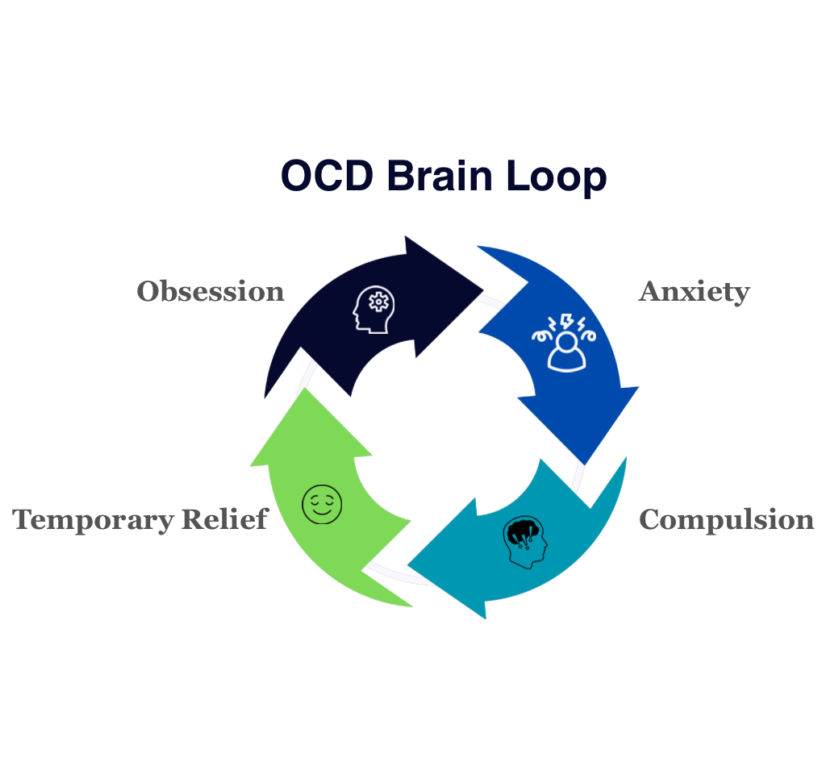
Brain circuits involved in error detection and threat response become overactive, while the systems responsible for stopping repetitive behaviours and evaluating risk become less effective. This makes intrusive thoughts feel persistent and difficult to dismiss.
Although this cycle can feel overwhelming, it is not permanent. The brain is adaptable, and with the right support it can learn to respond differently to intrusive thoughts, reducing anxiety and weakening compulsive patterns over time.
Approaches that help retrain attention, reduce reactivity, and build tolerance of uncertainty can support meaningful and lasting change.